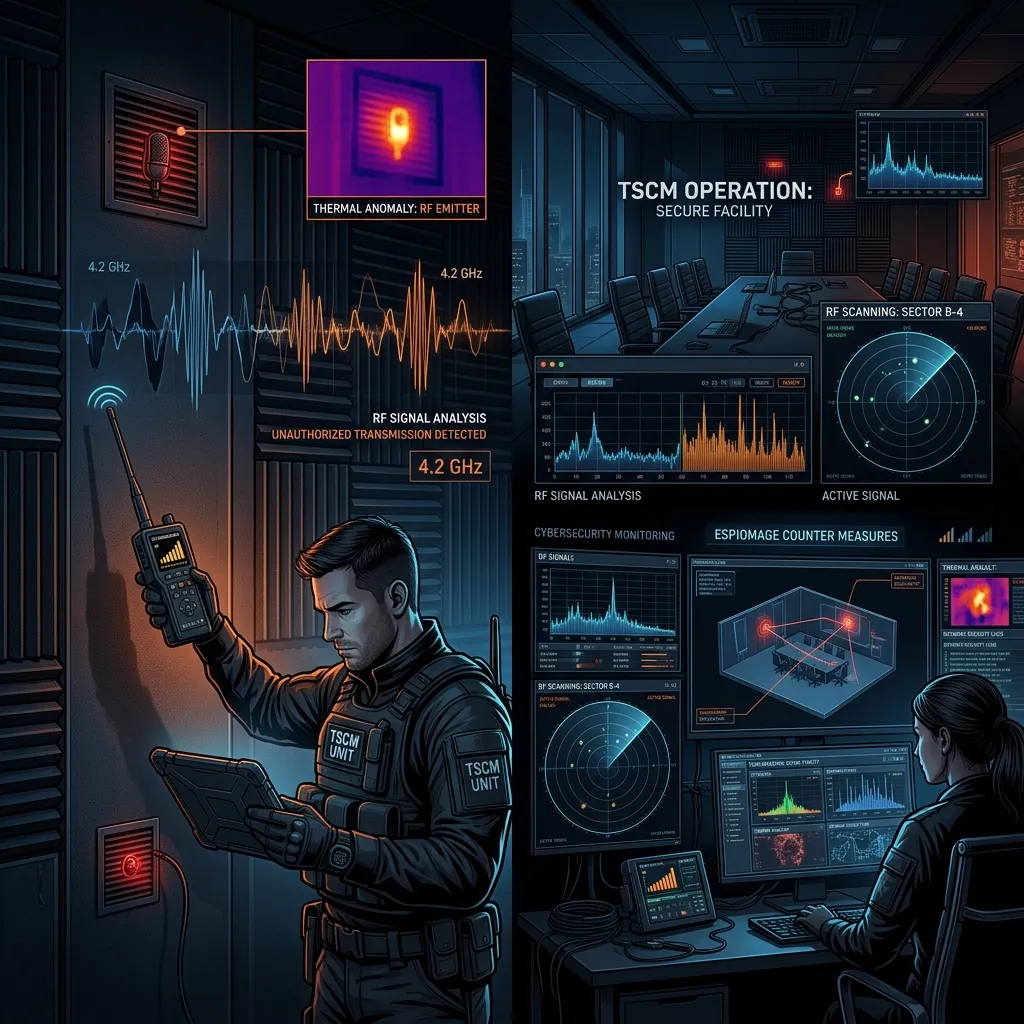
Technical Surveillance Counter-Measures (TSCM)
Corporate espionage is no longer the domain of spy novels; it is a multi-billion dollar reality. Competitors, disgruntled executives, and foreign state actors actively deploy sophisticated electronic surveillance devices to steal intellectual property, intercept merger negotiations, and compromise internal strategies. If your boardroom has not been swept, you cannot guarantee your conversations are private.
The Threat Landscape
Modern surveillance devices ("bugs") are incredibly advanced. They are no longer simple radio transmitters attached to phone lines. Today, adversaries utilize burst-transmission GSM bugs, laser microphones that read the vibrations off your office windows, and microscopic cameras embedded in innocuous objects like smoke detectors or USB charging cables.
These devices are designed to evade standard detection. Some are dormant, programmed to power on and record only when specific vocal frequencies are detected, or to transmit their data in a single, high-speed encrypted burst at 3:00 AM when the office is empty.
Our TSCM Methodology
Detecting elite surveillance equipment requires elite countermeasures. A visual inspection is completely insufficient. Our TSCM teams deploy military-grade detection hardware to perform comprehensive electronic sweeps.
- Radio Frequency (RF) Spectrum Analysis: We map the entire RF environment (from 10 kHz to 24 GHz) using advanced spectrum analyzers. We establish a baseline of normal electronic activity and surgically isolate rogue transmissions, including frequency-hopping and burst-transmission devices.
- Non-Linear Junction Detection (NLJD): Not all bugs are actively transmitting. Some are turned off, or their batteries have died. An NLJD transmits a directed microwave signal that forces the silicon junctions inside any semiconductor (hidden microphones, memory cards) to resonate, allowing us to find bugs even when they are completely dead or encased in concrete.
- Thermal Imaging Analysis: Any operating electronic device generates heat, no matter how small. We utilize highly sensitive Forward Looking Infrared (FLIR) cameras to detect the microscopic thermal anomalies of hidden circuitry operating behind drywall or inside acoustic ceiling tiles.
- Cyber-Physical Inspection: Modern corporate espionage often involves compromising existing infrastructure. We analyze VOIP phones, teleconferencing equipment, and smart-office IoT devices to ensure they have not been maliciously reprogrammed to act as listening posts.
Operational Security (OPSEC) Protocol
If you suspect your office or residence is compromised, do not discuss your suspicions while in the suspected environment. Do not use your corporate phone or Wi-Fi to research TSCM services. Call us from a sterile, unassociated device in a completely different physical location. Discussing a sweep in a compromised room will alert the adversary, allowing them to remotely deactivate or retrieve the device before our team arrives.
Strategic Containment
If a device is discovered, the immediate instinct is to destroy it. This is a critical error. Finding the bug is only the first step. Our operatives will discreetly isolate the device while leaving it in place, allowing your legal and executive teams to feed the adversary strategic disinformation while our digital forensics unit traces the transmission back to its source.