24/7 Emergency Cyber Strike Team & Ransomware Recovery
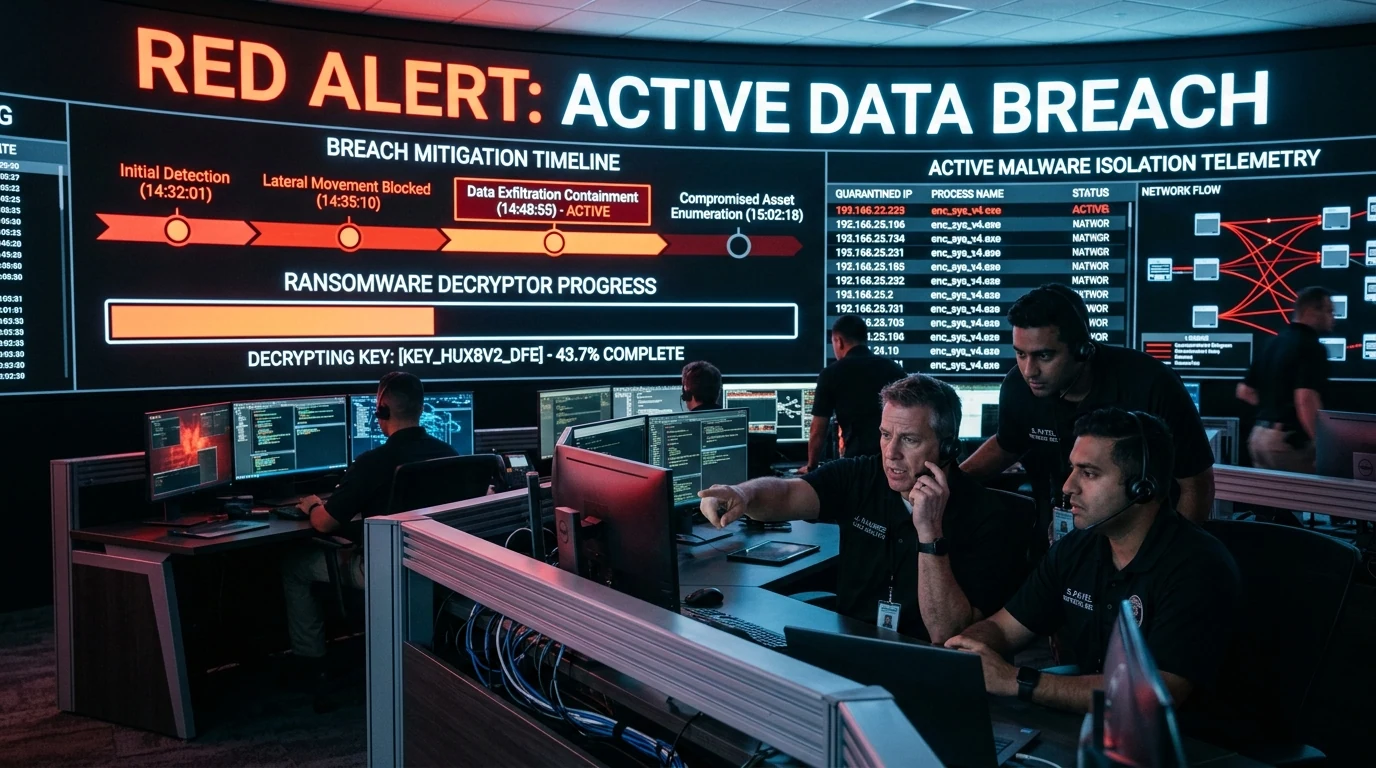
Active ransomware infection or critical data breach? Deploy our emergency cyber strike team within minutes to halt adversary access, decrypt locked systems, and restore business operations.
Elite Privacy
NDA-protected
24hr Response
Initial review
Global Ops
Worldwide coverage
What We Test
Targeted assessment areas included in every engagement.
- Instant remote & on-site active breach containment
- Ransomware negotiation, threat actor communication & decryptor testing
- Malware, rootkit & persistent backdoor eradication
- Emergency business continuity & immutable backup restoration
- Root-cause timeline analysis & corporate disclosure reporting
- Post-incident perimeter hardening & threat immunity deployment
Why You Need an Elite Cyber Strike Team Right Now
In the first 4 hours of a ransomware attack, threat actors are exfiltrating sensitive IP and wiping online backups.
Our battle-tested responders immediately sever attacker C2 channels, isolate infected subnets without crashing core databases, and execute proven recovery playbooks to get your company back in business without paying unnecessary ransoms.
In-Scope Capabilities
Technical capabilities included in every emergency incident response & ransomware recovery engagement.
24/7 rapid emergency strike team
Immediate remote or on-site deployment within minutes to halt live intrusions, contain malware, and stop data exfiltration.
Ransomware negotiation & decryptor recovery
Tactical adversary communication, safe payment escrow if required, decryption assistance, and immutable backup restoration.
Malware eradication & backdoor neutralization
Surgical removal of persistence mechanisms, rootkits, web shells, and adversary C2 channels across your entire network.
Root-cause forensic analysis & breach timeline
Meticulous analysis of patient zero, initial access vectors, affected files, and corporate incident documentation.
Business continuity & rapid operational restoration
Restoring mission-critical servers, databases, and communication pipelines with hardened security controls to resume business.
Post-breach hardening & immunity protocols
Deploying endpoint detection, zero-trust controls, and network segmentation to ensure adversaries cannot re-infect systems.
Engagement Timeline
A structured, repeatable process that reduces uncertainty and delivers results.
Emergency Call & Triage
Direct hotline engagement with an incident commander in under 15 minutes
Containment & Severance
Isolate attacker entry points, freeze compromised credentials, and stop data leaks
Eradication & Decryption
Purge adversary tools, recover encrypted files, and restore clean system states
Hardening & Assurance
Deploy 24/7 telemetry monitoring and issue an airtight Post-Breach Certification
Proven Results
< 60 min
Average Triage Response
Zero
Data Lost in Managed Recoveries
24/7/365
Active SOC Strike Readiness
Successfully containing multi-million dollar ransomware deployments and intrusions for healthcare systems, enterprise SaaS, logistics, and private businesses.
What You Receive
Every engagement concludes with comprehensive documentation designed for both technical teams and executive stakeholders.
Deploy Emergency ResponseReady to start your assessment?
Scope review typically completed within 24 hours.
The moment an organization realizes it has been compromised, the clock begins ticking. In the chaos of a cyberattack—whether it's a crippling ransomware deployment, a covert data exfiltration campaign, or a targeted denial-of-service attack—every minute of hesitation amplifies the financial and reputational damage. Incident Response (IR) is not a theoretical exercise; it is an emergency medical procedure for your digital infrastructure. Survival depends entirely on the speed, expertise, and precision of the response team.
TheCyberIntelLabs provides elite, rapid-deployment Incident Response services designed to immediately seize control of the situation. We do not just advise; we act. Our seasoned incident commanders, forensic analysts, and reverse engineers have battled the world's most sophisticated threat actors on the front lines. We bring order to chaos, executing a meticulously structured containment and eradication strategy that stops the bleeding and begins the restoration process.
Our approach to incident response is holistic, encompassing not only the technical neutralization of the threat but also the strategic management of the crisis. We coordinate with your internal IT teams, legal counsel, and executive leadership to ensure that decisions are made based on hard forensic facts, not panic. From the initial triage to the final post-incident report, our objective is to minimize downtime, preserve critical evidence, and return your organization to secure, operational normalcy as rapidly as possible.
Rapid Deployment and Triage: Securing the Patient
When an incident is declared, our 24/7 Emergency Response Team mobilizes immediately. The initial phase of triage is hyper-focused on one objective: scoping the breach. We rapidly deploy specialized endpoint detection and response (EDR) agents across your infrastructure to gain immediate visibility into the network. This allows us to identify the 'patient zero' workstation, map the lateral movement of the attackers, and determine the exact nature of the compromise.
During triage, we work to identify the adversary's Tactics, Techniques, and Procedures (TTPs). Are we dealing with an automated ransomware script or an interactive 'hands-on-keyboard' threat actor? Have they established persistent backdoors? Have administrative credentials been compromised? By answering these critical questions within the first few hours, we formulate a highly targeted containment strategy, preventing the adversary from causing further damage or pivoting to unaffected segments of the network.
Simultaneously, we establish secure, out-of-band communication channels for the incident response team and key stakeholders. It is highly likely that the attacker has compromised corporate email or messaging platforms; communicating securely ensures that the adversary is not monitoring our response strategy.
Aggressive Containment and Eradication
Once the scope of the breach is understood, we move to aggressive containment. This is the technical equivalent of quarantining an infection. We do not haphazardly unplug servers or wipe workstations, as this destroys volatile memory and critical forensic evidence. Instead, we execute precise, surgical containment measures. We isolate compromised subnets using firewalls and VLAN configurations, sever unauthorized external connections, and force global password resets across all identity providers (such as Active Directory).
With the adversary boxed in, the eradication phase begins. This involves the systematic removal of the threat from the environment. Our forensic analysts hunt for and neutralize all identified malware, ransomware payloads, and persistent mechanisms, such as scheduled tasks, malicious registry keys, or hidden services.
If the adversary has established backdoors or compromised VPN credentials, we close those avenues of access permanently. Throughout the eradication process, we continuously monitor the network for signs of re-entry. Threat actors frequently attempt to regain access once they realize they are being evicted; our team remains vigilant, neutralizing counter-attacks in real-time until the environment is definitively secured.
Ransomware Negotiation and Recovery Strategy
Ransomware incidents represent a unique crisis management scenario. If your organization is facing encrypted critical systems and the threat of double-extortion (where data is stolen and threatened to be published), navigating the extortion demands requires specialized expertise. Our incident commanders provide strategic guidance throughout this highly volatile process.
We first conduct a rapid viability assessment of your backups. If viable, uncorrupted backups exist, we focus entirely on secure restoration and environment hardening, rendering the ransom demand irrelevant. However, if backups are destroyed or data exfiltration poses an existential threat to the company, we can facilitate strategic communication with the threat actors. Our team analyzes the specific ransomware variant to determine if a known decryption key exists or if the threat group has a reliable history of providing decryptors.
If engagement is necessary, we handle all communication through secure, anonymous channels. We utilize intelligence profiling to understand the specific syndicate we are dealing with, delaying their timelines while we continue forensic investigation and recovery efforts. Our ultimate goal is to restore business operations while minimizing financial loss and reputational exposure.
Forensic Investigation and Root Cause Analysis
Stopping the attack is only half the battle; understanding exactly how it happened is critical to preventing a recurrence. Parallel to containment and recovery, our digital forensics team conducts a deep-dive investigation to establish a definitive timeline of events. We acquire forensic images of compromised systems, analyzing memory dumps, file system artifacts, and event logs.
We trace the attack back to the initial vector of compromise—whether it was a spear-phishing email containing a malicious macro, an unpatched vulnerability on a public-facing web server, or the exploitation of stolen VPN credentials. We document every action the attacker took, files they accessed, and data they exfiltrated.
This rigorous root cause analysis is essential for operational transparency. If sensitive customer data or Personally Identifiable Information (PII) was exposed, organizations need to understand the exact scope of the breach. Our forensic documentation provides the unassailable, verified facts required by corporate stakeholders and cyber insurance providers.
Strategic Recovery and Resilience Hardening
Recovery is not simply about restoring systems to their pre-incident state. Restoring a vulnerable system merely invites a secondary attack. Our recovery phase involves strategically bringing systems back online in a prioritized, secure manner. We implement immediate hardening measures—deploying advanced endpoint protection, enforcing Multi-Factor Authentication (MFA), and applying critical patches—before any system is reconnected to the production network.
Following the successful resolution of the incident, we deliver a comprehensive Post-Incident Report. This document details the complete chronology of the attack, the forensic findings, and the actions taken during the response. More importantly, it provides a strategic roadmap for security enhancement.
We identify systemic weaknesses in your security architecture, policies, and personnel training, providing actionable, prioritized recommendations to significantly elevate your security posture. Our goal is to ensure that your organization emerges from the crisis stronger, more resilient, and infinitely better prepared to defend against the next wave of cyber threats.
A cyberattack is one of the most stressful and critical events an organization can face. The difference between a devastating business collapse and a manageable security incident lies entirely in the speed and expertise of the response. When your perimeter is breached, you cannot rely on automated tools or inexperienced IT staff; you require a battle-tested incident response force.
TheCyberIntelLabs stands ready to deploy elite incident commanders and forensic specialists to your defense. We operate with absolute discretion, technical superiority, and an unwavering commitment to restoring your operational capability. Do not face a crisis alone. Contact our Emergency Response Team immediately to neutralize the threat, secure your infrastructure, and reclaim control of your digital environment.
Deploy Emergency Response
Submit the technical details of your request below. Our team responds within 24 hours with a tailored scope review.
Other Capabilities
Need Immediate Technical Assistance?
For active breaches or urgent investigations, priority channels are available.