The Calculus of Authentication Bypass
Authentication is the primary gateway defending the core logic and sensitive data of a web application. Consequently, it is the most heavily fortified and intensely scrutinized component of any system. Fuzzing an authentication endpoint requires abandoning the brute-force spray-and-pray methodologies of directory enumeration, and adopting a highly calculated, statistically driven approach. The goal is no longer just finding the door; the goal is quietly picking the lock before the alarms are triggered.
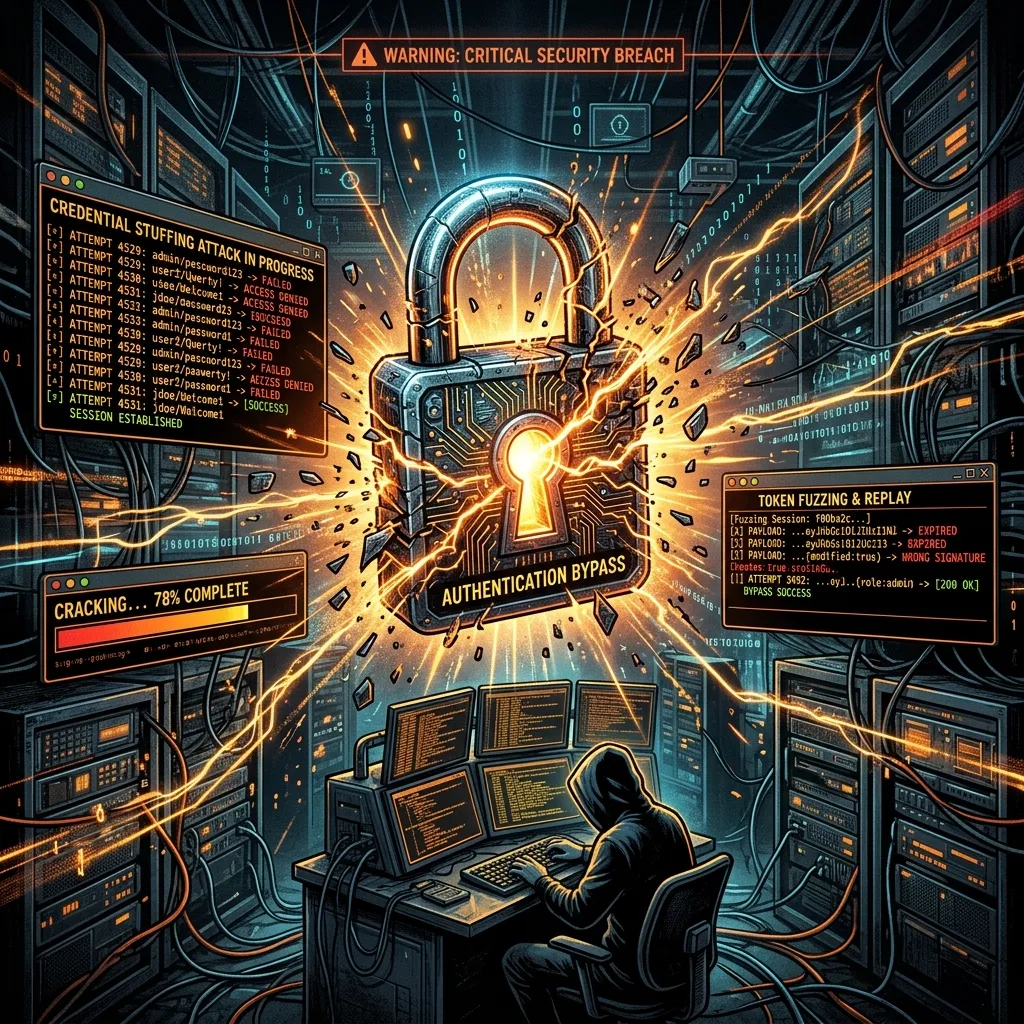
The Evolution of Credential Stuffing
Traditional brute-forcing—iterating through every possible combination of letters and numbers (e.g., AAAAA, AAAAB)—is mathematically obsolete against modern cryptographic hashing and network latency. The standard attack vector today is Credential Stuffing.
When a major service (like LinkedIn or Adobe) is breached, millions of username and password combinations are dumped onto the dark web. Because humans inherently reuse passwords across multiple services, attackers compile these massive lists and load them into specialized authentication fuzzers. The fuzzer automatically injects these known-valid credentials into the login portal of the target organization.
If a corporate employee uses the same password for their Netflix account and their Enterprise VPN, a breach at Netflix guarantees a breach of the corporate network. The fuzzer does not need to guess the password; it simply leverages the cryptographic failures of adjacent services.
The Password Mutation Engine
To increase the success rate of credential stuffing, elite fuzzers utilize rule-based mutation engines (like Hashcat's ruleset). If the breached password is Summer2023!, the mutation engine will automatically generate and inject variations like Autumn2023!, Winter2024!, and CompanySummer! before moving to the next user, effectively bypassing mandatory 90-day password reset policies.
Evading Rate Limits and Account Lockouts
The immediate defense against credential stuffing is the Rate Limit and the Account Lockout. If a user inputs the wrong password five times, the account is locked for thirty minutes. If a single IP address makes a hundred login attempts in a minute, the IP is permanently blocked by the Web Application Firewall (WAF).
Fuzzing authentication requires surgically bypassing these controls.
- IP Rotation: Attackers never fuzz from a single IP. They utilize tools like Proxychains or AWS API Gateway to route their HTTP requests through thousands of residential proxies. To the WAF, the attack looks like a thousand different legitimate users trying to log in once, rather than one attacker trying a thousand times.
- Horizontal Brute-Forcing: To bypass account lockouts (which trigger after 5 failed attempts on a single account), attackers pivot horizontally. Instead of trying 1,000 passwords on the `admin` account, they try 1 highly probable password (e.g., `Password123!`) across 1,000 different user accounts. This guarantees that no single account ever hits the 5-attempt lockout threshold.
- Header Spoofing: Many rudimentary rate limiters track users by the `X-Forwarded-For` or `Client-IP` HTTP headers. Advanced fuzzers randomize these headers on every single request, tricking the load balancer into resetting the rate-limit counter.
Username Enumeration via Time-Based Fuzzing
Before an attacker can execute a password attack, they need a list of valid usernames. Modern applications attempt to obscure this by returning a generic error message: "Invalid username or password." This prevents the attacker from knowing if they guessed the username correctly.
However, the backend database logic betrays the application through Time-Based Enumeration. When a login request hits the server, the backend executes a SQL query to find the user. If the user does not exist, the query returns instantly, and the server replies with an error. If the user does exist, the server then takes the provided password, runs it through an intensive cryptographic hashing algorithm (like Bcrypt or Argon2), and compares the hashes. This hashing process takes significantly longer—often 200 to 500 milliseconds.
A penetration tester utilizes a fuzzer to inject a list of potential usernames with a dummy password. The fuzzer meticulously records the HTTP response times down to the millisecond. If the response takes 10ms, the username is invalid. If the response takes 300ms, the attacker has mathematically confirmed that the username exists in the database, because the server was forced to compute the Bcrypt hash. The generic error message is rendered irrelevant by the acoustic signature of the CPU.
Token Fuzzing and JSON Web Tokens (JWT)
Modern authentication architectures have largely abandoned server-side session cookies in favor of stateless JSON Web Tokens (JWTs). A JWT is a Base64-encoded JSON object that cryptographically proves the user's identity. It is composed of a Header, a Payload, and a Signature.
When fuzzing an application utilizing JWTs, the target shifts from the login portal to the token itself. If an attacker captures their own low-privileged JWT, they will load it into a specialized JWT fuzzer. The objective is to manipulate the token's Payload (e.g., changing "role": "user" to "role": "admin") and forge a valid cryptographic Signature to force the server to accept the tampered token.
The "None" Algorithm Attack
The JWT Header dictates which cryptographic algorithm was used to sign the token (e.g., "alg": "HS256"). Historically, many JWT libraries supported an algorithm simply called "none", intended for debugging purposes. A fuzzer will systematically alter the Header to "alg": "none", strip the Signature entirely, and elevate the privileges in the Payload. If the backend server fails to explicitly reject the "none" algorithm, it will blindly trust the tampered token, granting the attacker instant administrative access without ever needing a password.
Secret Key Brute-Forcing
If the token uses standard HMAC-SHA256 (HS256) encryption, the security of the entire application rests on a single "Secret Key" stored on the server. If this key is weak (e.g., "secret", "12345", "companyname"), the attacker can perform an offline brute-force attack. They download the JWT and use a tool like Hashcat to rapidly hash millions of potential secret keys against the token's Signature. Because this attack occurs offline on the attacker's GPU cluster, there are no rate limits. Once the secret key is cracked, the attacker can forge perfectly valid JWTs for any user in the system indefinitely.
Conclusion: The Zero-Trust Imperative
Authentication bypass vulnerabilities represent catastrophic failures of security architecture. Defending against these advanced fuzzing techniques requires moving beyond simple passwords. It mandates the implementation of Multi-Factor Authentication (MFA) to neutralize credential stuffing, the deployment of behavioral analytics to detect horizontal brute-forcing, and the strict enforcement of cryptographic standards for all session tokens. In the modern threat landscape, the assumption must always be that the perimeter will be breached; true security relies on verifying every transaction, every time.